PHYSICS DIAGNOSTIC TEST -- WHAT TO STUDY?
The PDT is designed to test the knowledge of physics that you retained from your last course. Therefore, studying should not be necessary. If you insist, however:
For those wishing to enter PHYS 1101 or PHYS 1125:
The PDT is designed to see that you have a working knowledge of the topics covered in BC secondary school physics 12 or Physics 1118.
Topics:
- One and two-dimensional kinematics, Newton's laws, gravity and circular motion, momentum, work and energy, static equilibrium, electric charges, forces and fields, electric potential, electric currents, magnetism and induction, refraction of light and lenses.
Review books:
- SOLARO Study Guides: Physics 12. Covers the BC grade 12 physics curriculum – this series was previously called The Key.
Library Reserves 1st floor, call number QC 32 K49 2016
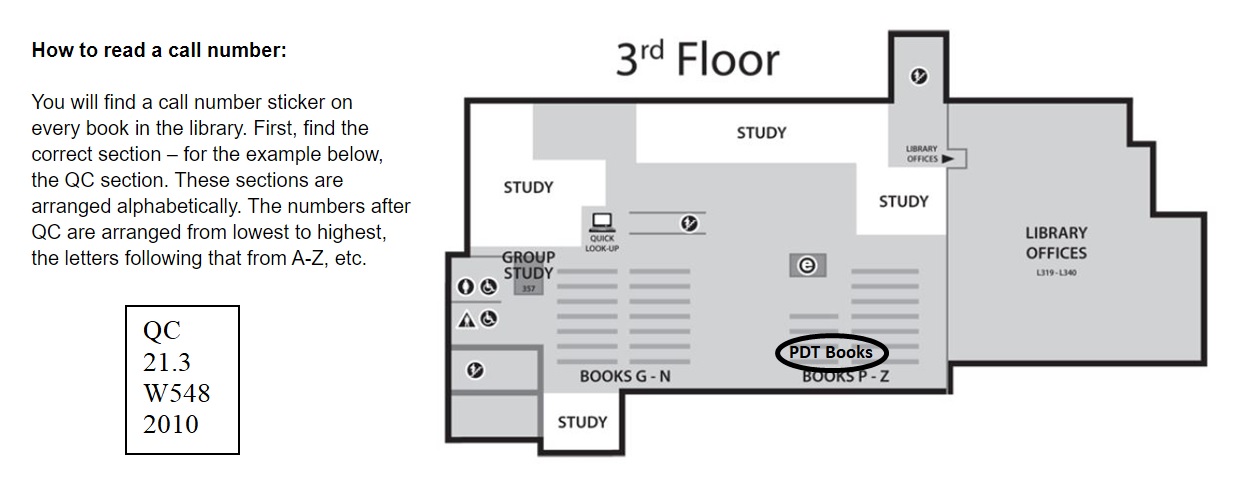
Library 3rd floor, older editions QC 32 K49 2003 and 2011 (titled The Key) may also be useful.
- OpenStax College Physics. Free online textbook available here: https://openstax.org/details/books/college-physics
- College Physics 7th ed, D. Wilson & Buffa. 2010
Library 3rd floor, call number QC 21.3 W548 2007 or 2010.
- Other introductory college physics books based on algebra (not calculus) in the call number range QC 21-32, Library 3rd floor. For example:
- College Physics. Etkina, Gentile, & van Heuvelen, 2014
Library 3rd floor, call number QC 21.3 E853 2014 - Schaum’s Outline: College Physics 12th ed. 2018
Library 3rd floor, call number QC 21.3 H43 2018
- College Physics. Etkina, Gentile, & van Heuvelen, 2014
The test is multiple choice. You will be provided with a formula sheet.
For those wishing to enter PHYS 1118:
The PDT is designed to see that you have a working knowledge of the topics covered in BC secondary school Physics 11 or Physics 1114.
Topics:
- Kinematics, vectors, Newton's laws, work and energy, temperature and heat, momentum and collisions, fluids, periodic motion, waves and sound, electricity, electromagnetic waves and reflection of light, refraction of light and lenses.
Review books:
- SOLARO Study Guides: Physics 11. Covers the BC grade 11 physics curriculum – this series was previously called The Key.
Library Reserves 1st floor, call number QC 32 K48 2016__
Library 3rd floor, older editions QC 32 K48 2003, 2006, and 2011 (titled The Key) may also be useful. - Other introductory college physics books based on algebra (not calculus) in the call number range QC 21-32, Library 3rd floor.
The test is multiple choice. You will be provided with a formula sheet.
Practice Tests:
- For examples of multiple choice physics tests, you can see the BC Physics 12 exams online at: http://www.bced.gov.bc.ca/exams/search/.